
Septic System
Hot summer, uncertain rain: getting your Central Coast septic system ready for the holidays
The Bureau of Meteorology expects a hot summer in eastern NSW but has no clear wet or dry call for the NSW coast, so Central Coast septic owners should plan for a full house, a heatwave and a sudden downpour, not a wet December.
What does BOM's summer outlook say for the Central Coast?
Reading BOM's summer outlook for a Central Coast block
Step 1: Where are you?
The Central Coast is coastal NSW, east of the Divide.
Step 2: What changed on rain?
The 29 October outlook (November to January) said above-average rain was likely for "northern New South Wales", with the wet signal strengthening in the east during December.
The 19 November outlook (December to February) narrows this to a 60% to over 70% chance of above-average rain for "parts of southern Queensland and north-eastern New South Wales, along and west of the Divide".
For southern and coastal NSW it says "no clear signal for either wetter or drier conditions" (roughly equal chances above or below average).
Step 3: What about heat?
Over 70% chance of unusually high maximum temperatures across eastern NSW.
The answer Plan for heat and a full house. Keep a wet-weather plan ready.
Hot is the firm call. Wet is not. If you heard a wet December was on its way, that forecast has since moved away from the coast.
Here is the working. The Bureau of Meteorology's outlook of 29 October said above-average rain was likely for northern New South Wales, with the wet signal strengthening in the east during December. The latest outlook, issued on 19 November, covers December to February. It moves the likely wet to parts of southern Queensland and north-eastern New South Wales, along and west of the Divide, with a 60% to over 70% chance. The Central Coast is coastal NSW, east of the Divide. For that strip, BOM now says there is "no clear signal for either wetter or drier conditions for the season".
The heat is a different story. Daytime temperatures are very likely to be above average across most of Australia. BOM gives an over 70% chance of unusually high maximum temperatures across eastern parts of New South Wales. The nights look warm too, with minimums very likely above average and "3 to 4 times the normal likelihood" of unusually high minimums across much of the country. The fire season is already running too: the official bush fire danger period for most of NSW began on 1 October.
So the plan for a septic system this summer has three parts: a full house, a run of hot days, and a downpour that may or may not arrive. Outlooks get revised, so look at BOM's current outlook again before Christmas.
Does a strong El Niño mean a dry summer?
"does not necessarily mean strong impacts on Australia's rainfall and temperature"
A strong El Niño does not mean a dry summer: BOM says El Niño strength doesn't always match the impact on Australia's rainfall and temperature.
This year's El Niño is a big one. BOM says it is likely to peak around November to December as a very strong event, then adds that this "does not necessarily mean strong impacts on Australia's rainfall and temperature". El Niño's influence on rain usually reduces around early summer.
The last El Niño summer is a useful reminder. In 2023-24, storms along the east coast and tropical cyclones brought above-average rain to widespread areas. BOM also says a warming climate is increasing the likelihood and severity of heatwaves and of "heavy rainfall and flooding events". Its late-October outlook noted that warmer seas can fuel storms and rain systems, increasing potential for high intensity rainfall.
No signal is not the same as no storm. Keep the wet-weather plan in the drawer, ready to use.
How do heat and a full house load a septic system?
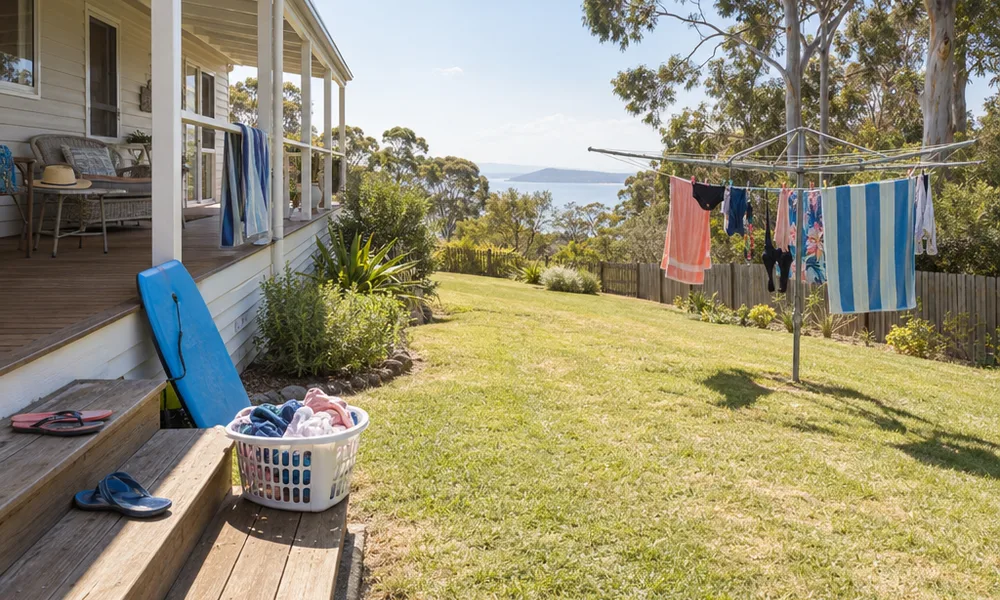
Holiday weeks change how a house uses water. Guests arrive, the beach towels pile up, and everyone showers after the surf and again before bed. A septic tank and its trench cope best with a steady flow. They cope worst with a surge.
Northern Beaches Council, another NSW council, sets out the owner's side of the job. Running the system could mean conserving water, minimising chemical cleaners and avoiding large or sudden loads of waste water. Here is what that looks like in a full house:
- Spread the washing across the week, not one marathon day of towels and sheets.
- Stagger showers through the day where you can, and keep them short in a heatwave.
- Run the dishwasher only when it is full.
- Scrape ham fat, roast drippings and barbecue grease into the bin, never the sink.
- Go easy on bleach and strong cleaners.
- Fix the dripping tap or running cistern before anyone arrives. A small leak feeds the system all day and all night.
From Septic Tank Cleaning Central Coast's side of the fence, the most useful thing in a holiday house is one person who knows where the tank and trench are, and who tells the guests what goes down the drain.
Septic tank overflow after heavy rain: what to check first
After a storm: Northern Beaches Council's troubleshooting steps (another NSW council, not Central Coast)
| What you see | First move |
|---|---|
| Absorption trench wet or soggy, or surface water around it | "check for increase in water usage and reduce it" |
| Recent heavy rain | "divert storm-water away from the absorption area by building an earth bank" |
| Water flowing from the absorption trench | "contact your plumber"; trenches may need replacing; "desludging your tank provides only a temporary solution" |
| Blocked grease trap | Clean it and re-check. |
After a summer storm, walk the trench area. Look for soggy ground, pooling water, a sewage smell or drains that are slow to empty.
Northern Beaches Council's troubleshooting guide gives the first moves. If the trench is wet or soggy, or there is surface water around it, "check for increase in water usage and reduce it". After recent heavy rain, divert storm-water away from the absorption area by building an earth bank.
If water is flowing from the trench, the advice is to "contact your plumber". The trenches may need replacing, and the council warns that "desludging your tank provides only a temporary solution". A blocked grease trap should be cleaned and re-checked.
Keep children and dogs off any wet patch over the trench until it has been looked at. If your trench has given trouble before, our page on absorption trenches explains how they work.
How do you keep stormwater off the absorption trench?
Keeping a downpour off the trench: the block from above
A trench is built to take the water from your house, not the water from your roof, your driveway and the block uphill. In a downpour, all of that runs downhill, and too often it runs straight across the trench.
Before the season turns, check where your downpipes and driveway runoff end up. If they point at the trench, redirect them. The earth bank in the drawing is the step Northern Beaches Council names. It is a low mound uphill of the trench that turns the flow around it. Keep cars, trailers and boats off the trench area too, especially when the ground is wet.
Water left sitting around the system brings a summer problem of its own. Our page on mosquitoes and septic systems covers that.
Septic tank pump out before Christmas: a pre-holiday checklist
Before the holidays: tick as you go
Whether your tank needs a pump-out before the holidays depends on when it was last done and how hard the house uses it. Our septic pump-out guide covers how often. Then work down this list:
- Know your last service date. If nobody in the house knows it, that is your answer about what to do first.
- Read your approval's conditions. Our page on the approval questions owners should ask shows what to look for.
- Aerated system (AWTS)? Check its service schedule on your own approval. As one NSW example, Penrith City Council says an AWTS in its area must be serviced by a qualified technician every three months. Penrith ties this to the NSW Health accreditation and the Approval to Operate.
- Fix leaking taps and running cisterns.
- Clean the grease trap if you have one, and keep cooking fat in the bin.
- Ease off chemical cleaners.
- Plan the washing so it spreads across the week.
- Find the tank lids and the trench, and keep vehicles off the trench.
- Check BOM's current outlook again in the week before Christmas.
Talk to us before the house fills up
Maybe you don't know when the tank was last pumped out. Maybe the trench went soggy after the last big storm. Maybe the house is about to sleep twice its usual number. If any of these is true, ring now, not on Boxing Day. Tell Septic Tank Cleaning Central Coast what kind of system you have, when it was last serviced and how many people you are expecting, and talk through what your tank needs before the holidays. Reach us through our contact page, or use the enquiry form below this article.
Sources
- Climate outlooks: weeks, months and seasons, Bureau of Meteorology
- Climate outlook archive, 29 October 2026, Bureau of Meteorology
- El Niño strength doesn't always match impact on Australia, Bureau of Meteorology
- Preparations for bush fire season advance, NSW Government
- On-site sewage systems, Northern Beaches Council
- On-site sewage management, Penrith City Council