
Septic System
Buying a house with a septic tank on the Central Coast: the approval questions to ask before you exchange
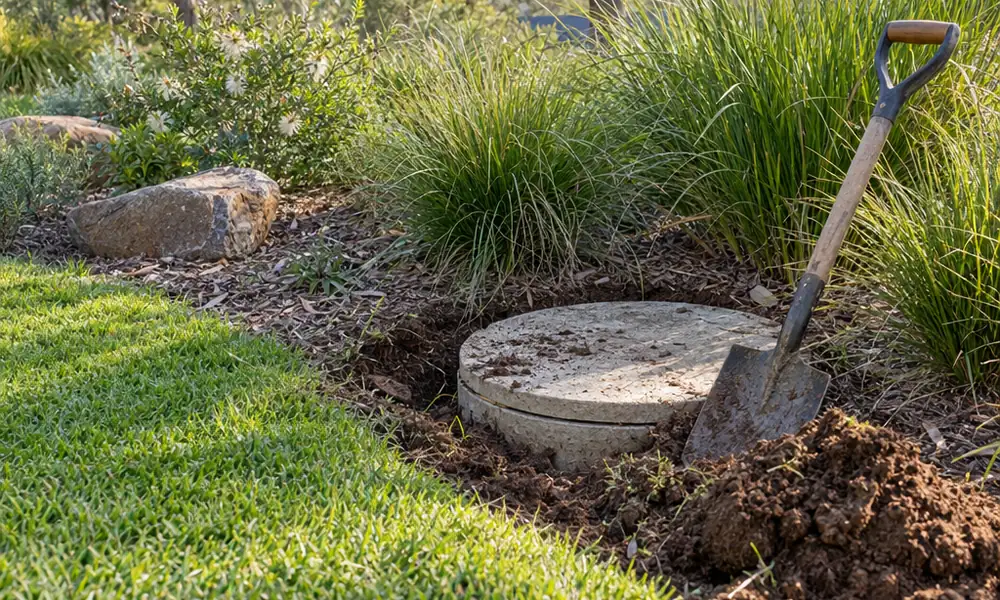
Illustration: a garden spade beside a partly uncovered septic lid
Buying a house with a septic tank: what to ask before you exchange
0$330
Get the septic paperwork before you exchange, because the contract may not bring it to you. The NSW Government's steps to selling a property list what a sale contract must contain: the title search, registered plan, a drainage diagram, a current s 10.7 zoning certificate and the cooling-off statement. Septic approval is not on that list.
Here is why that gap is worth a phone call. Applying for an approval to operate an onsite sewage management system from Central Coast Council costs $80.30 for a domestic system (checked October 2026). Operating a system without council approval is an offence, and the infringement notice amount is $330 (checked October 2026).
By our working, the on-the-spot penalty is roughly four times the domestic application fee. Asking the questions is the cheap end of that comparison.
At Septic Tank Cleaning Central Coast, our advice to buyers is simple. Before exchange, ask for three things: the current approval to operate, the pump-out and service records, and any council notices about the system. Get your conveyancer to raise them in writing.
Do I need a new approval to operate when I buy?
As the owner of the property, it is your responsibility to ensure that the system is approved by your local council and that it is working properly.
Do not assume the approval simply comes with the house: one NSW council tells buyers they "need to apply for Approval to Operate within 3 months of property transfer".
That is another council's wording, not a Central Coast rule. Central Coast Council is the authority that confirms whether a new owner applies fresh or transfers the existing approval, and how long you have. Ask it directly on 02 4306 7900 or ask@centralcoast.nsw.gov.au.
The council's listing gives the 2026-27 domestic fees as $80.30 to apply and $86.05 to renew (checked October 2026). Commercial systems are $304.10 to apply and $149.15 to renew (checked October 2026). The listing also says "further fees may apply".
The records matter for the application itself. It must set out how the system will be operated, maintained and serviced, and what happens if it breaks down. A buyer holding the previous owner's service history has most of that story already.
Once you own the property, the duty is yours. The NSW Office of Local Government puts it plainly on its water safety and management page: the owner is responsible for making sure the system is approved by council and working properly.
What if the seller altered the system?
Changing a system needs a different approval. Council's approval to install, construct or alter is separate from the approval to operate, and is often granted as part of a Development Application. The 2026-27 fees are $854.85 to install a domestic system and $298.35 to alter an existing one (checked October 2026). The plumbing and drainage work must be done by licensed people.
Council's draft Regulatory Priorities Statement 2026-2029, which was open for comment until 21 August 2026, lists unauthorised works on private property among its 2026-27 yearly priorities. If the system looks newer than the house, ask whether the work had approval. Our earlier piece on what replaced the Silver Book covers the two approvals in more detail.
Is septic approval part of the sale contract?
A NSW sale contract must contain
- title search
- registered plan
- drainage diagram
- current s 10.7 zoning certificate
- cooling-off statement
Ask for separately (not on that list)
- current septic approval to operate
- pump-out and service records
- any council notices about the system
- service agent reports, if the system is aerated
Leaving out a required document can let the buyer rescind within 14 days of exchange unless settlement has occurred. Septic approval is not on the NSW Government's list of required documents.
Not on the NSW list. The required contract documents are the title search, registered plan, drainage diagram, s 10.7 zoning certificate and cooling-off statement.
The same page says leaving out a required disclosure document can let the buyer rescind within 14 days of exchange, unless settlement has occurred. That remedy is tied to the required documents. Septic approval is not on the NSW Government's list of them, so do not count on it as a safety net for septic questions.
When do the septic checks have to happen?
Before exchange
ask for approval, records, notices (the only window at auction)
Exchange
Cooling-off, private treaty
usually 5 working days, can be waived, reduced or extended. None at auction.
Settlement
typically about 6 weeks after exchange
After settlement
confirm approval with Central Coast Council, 02 4306 7900
Source: nsw.gov.au, steps to selling a property and ablis.business.gov.au, approval to operate
Your checks have to fit inside the sale's own windows. For a private-treaty sale, the NSW Government says buyers usually get a 5 working-day cooling-off period, which can be waived, reduced or extended. Settlement typically occurs about 6 weeks after exchange.
At auction there is no cooling-off at all. If you are bidding, every septic question needs its answer before the hammer falls.
Five working days goes quickly. Ask for the approval and records as soon as you are serious about the property, not after you have signed.
Does a building inspection cover the septic system?
Do not assume it does. Junee Shire Council tells buyers that building inspections do not cover septic systems, and that repair or replacement "can be expensive". It recommends a pre-purchase inspection, and says you can also request a summary of council records about the system.
Councils differ on what they offer. Ask Central Coast Council what records or inspections it provides for a property you are buying.
- access lid at ground level
- inlet pipe from the house
- inlet baffle
- scum layer on top
- liquid layer
- sludge layer on the floor
- outlet baffle
- outlet pipe to the trench
What a pump-out lets an operator see: lid access, layer depths, baffles. Not a council compliance check.
A pump-out gives you a practical look inside. With the tank emptied and the lid off, an operator can see whether the lid is reachable, how deep the sludge and scum layers were, and what state the inlet and outlet baffles are in. That is useful information for a buyer.
It is not a compliance certificate. Whether the system is approved is council's question, and only council answers it.
Aerated systems come with extra paperwork
Junee notes that aerated wastewater treatment systems must be maintained by a service agent, with reports to council quarterly, and that its on-site system fee is charged yearly on the rates notice. That is Junee's arrangement. If the house you are buying has an aerated system, ask the seller for the service agent's reports and ask Central Coast Council how servicing works under its approval.
Buying checklist: what to ask the seller and your conveyancer
Source: nsw.gov.au, steps to selling a property and ablis.business.gov.au, approval to install or alter
Keep this list with your conveyancer's file:
- The current approval to operate. It is not on the required contract list, so ask for it.
- Pump-out and service records, as far back as the seller has them.
- Any council notices about the system.
- For an aerated system, the service agent's reports.
- Whether any alteration had council's separate approval.
- Timing: before exchange at auction, or within the cooling-off window for a private-treaty sale.
Selling a house with a septic tank: what to have ready
A seller who hands over a tidy septic file answers the buyer's questions before they become conditions. Have these ready before you list:
- A copy of the current approval to operate.
- A note or sketch of where the tank and its lid are.
- The last pump-out invoice.
- Service records, and service agent reports if the system is aerated.
- Any approval for past alterations.
- Council's contact for the buyer: 02 4306 7900 or ask@centralcoast.nsw.gov.au.
If the last pump-out was years ago or the invoice is lost, a septic operator can do a fresh pump-out and give you a dated record. That is a practical document a buyer can read.
What to do in your first 30 days after settlement
The keys are yours, and so is the owner's responsibility for the system. A short list for the first month:
- Ring Central Coast Council on 02 4306 7900 to confirm the approval status and whether you need to apply or transfer.
- Find the tank lid. If it is buried deep or hard to lift, our page on the benefits of installing a septic tank riser explains one way to make it easier to reach.
- If the seller had no pump-out records, book a pump-out so you start with a known date.
- For an aerated system, confirm who the service agent is.
- Put the next service date in your calendar.
Could the approval rules change?
9 Oct to 6 Nov 2026
consultation on remaking the Local Government (General) Regulation 2021
Proposal
split into three regulations, including an Approvals and Orders regulation and a Council Governance and Operations regulation
1 Sep 2027
Regulation automatically repealed unless remade
Read the approval rules here as current, not permanent. The Local Government (General) Regulation 2021, which sits behind the approval to operate, is under statutory review. It is automatically repealed on 1 September 2027 unless remade, and the proposal splits it into three, including separate "Approvals and Orders" and "Council Governance and Operations" regulations. The consultation period is 9 October to 6 November 2026.
For a buyer, the practical point holds either way: ask Central Coast Council what applies on the day you buy.
The fees and time windows in one place
Apply for approval to operate, domestic, Central Coast 2026-27
$80.30 (checked October 2026)
Renew, domestic, 2026-27
$86.05 (checked October 2026)
Infringement notice, operating without approval
$330 (checked October 2026)
Cooling-off, private treaty
5 working days (none at auction; can be waived, reduced or extended)
Typical settlement
about 6 weeks after exchange
- Apply for a domestic approval to operate, Central Coast 2026-27: $80.30 (checked October 2026).
- Renew a domestic approval, 2026-27: $86.05 (checked October 2026).
- Infringement notice for operating without approval: $330 (checked October 2026). The maximum Local Court fine is 20 penalty units.
- Cooling-off for a private-treaty sale: usually 5 working days, which can be waived, reduced or extended. None at auction.
- Settlement: typically about 6 weeks after exchange.
Your next step
If you are buying, ask for the approval, the records and any notices before you exchange. If you are selling, put that file together before the first open home.
Either way, a dated pump-out record is one of the easiest pieces to add. To arrange one before exchange or in your first weeks after settlement, tell Septic Tank Cleaning Central Coast what you need through our contact page.
Sources
- https://ablis.business.gov.au/service/nsw/approval-to-operate-an-onsite-sewage-management-system-central-coast-council/10299
- https://ablis.business.gov.au/service/nsw/approval-to-install-construct-or-alter-an-onsite-sewage-management-system-central-coast-council/9843
- https://lawcodes.judcom.nsw.gov.au/lawcodes/law-part/view/bol_code/144/law_code/3885/law_part_code/44784
- https://www.nsw.gov.au/housing-and-construction/buying-and-selling-property/selling-a-property/steps-to-selling-a-property
- https://www.junee.nsw.gov.au/regulatory-control/plumbing-drainage/on-site-sewerage-management-system-approvals/
- https://www.olg.nsw.gov.au/councils/infrastructure-and-services/services-to-communities/water-safety-and-management
- https://www.yourvoiceourcoast.com/regulatory-priorities-statement
- https://www.nsw.gov.au/have-your-say/local-government-regulation-review