
Septic System
What replaced the Silver Book? NSW's newer septic guidelines for Central Coast owners
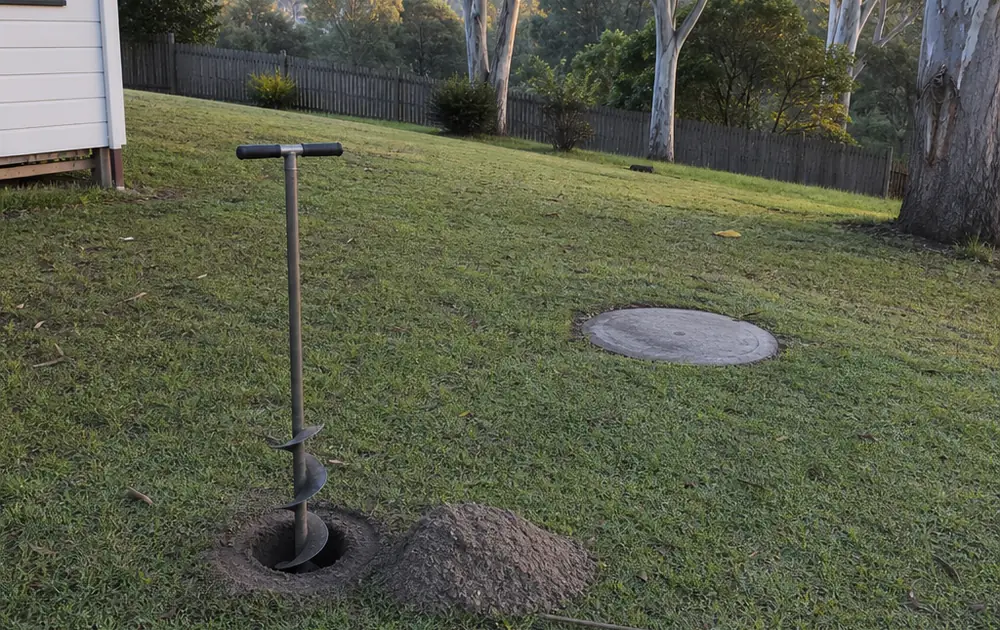
Illustration: a soil test hole bored in a backyard lawn
If someone tells you a septic plan has to meet "the Silver Book", they are quoting a document NSW has replaced. It came out in 1998, according to OLG's water safety and management page. Its replacement was issued on 9 April 2025, according to OLG's council circulars. That puts one rulebook in use for 27 years. That is our own count: 2025 minus 1998.
Here is what that means for you. The new Guidelines are written for councils. What you, as an owner, have to do still comes through your council's approvals.
What replaced the Silver Book?
1998
Environment & Health Protection Guidelines: Onsite Sewage Management for Single Households ('Silver Book')
27 years in use (our count: 2025 minus 1998)
Consultation to publication
Late June 2022
consultation survey
Source: einpresswire.com, Circular 25-05
2023
consultation draft
Source: einpresswire.com, Circular 25-05
9 April 2025
Circular 25-05 issues the Onsite Wastewater Management Guidelines
"Silver Book" was the everyday name for a state reference document that councils used to manage septic and other onsite systems. OLG's circulars page lists Circular 25-05, Onsite Wastewater Management Guidelines, issued 9/04/2025. It describes the Guidelines as "previously known as the Environment & Health Protection Guidelines: On-site Sewage Management for Single Households or Silver Book".
OLG's own water page is just as plain. The new Guidelines replace the Environment & Health Protection Guidelines: Onsite Sewage Management for Single Households or "Silver Book" (1998).
The 1998 Silver Book is no longer the current rulebook, because OLG states the 2025 Guidelines replace it.
The new edition was not rushed. The circular says feedback came from a survey in late June 2022 and a consultation draft in 2023. By our estimate, that is close to three years from the first survey to publication. Old names stick, so expect to keep hearing "Silver Book" from time to time.
What did the 2025 update change, and what did it not?
| Question | Answer |
|---|---|
| Old name | Silver Book (1998) |
| New name | Onsite Wastewater Management Guidelines |
| Who it is written for | Councils, to manage and regulate onsite wastewater systems |
| What kind of update | A technical update: technology, latest science, emerging land use trends Source: einpresswire.com, Circular 25-05 |
| Who directed it | OLG, NSW Health, DCCEEW (Town Water Risk Reduction Program), WaterNSW Source: einpresswire.com, Circular 25-05 |
| What it covers | Performance standards; systematic site and soil evaluation; a set approval process; council strategy advice; treatment and effluent technologies |
| New in this edition | A model wastewater strategy councils may refer to or adapt when next reviewing their own Source: einpresswire.com, Circular 25-05 |
| Where an owner's obligations come from | Council approvals under the Local Government Act and Regulation |
OLG calls it a technical update. The circular, published as an Office of Local Government release on EIN Presswire, describes it as "a technical update to capture technological advancements, the latest scientific literature and emerging trends in land use".
It was developed under the direction of OLG, NSW Health, the Department of Climate Change, Environment, Energy and Water (Town Water Risk Reduction Program) and WaterNSW. The Guidelines also remain the primary reference document for OWM in NSW, where OWM means onsite wastewater management.
According to OLG's water page, the Guidelines cover:
- performance standards
- systematic site and soil evaluation
- simplifying approval through a set process
- advice on updating a council's wastewater strategy
- technologies for treatment and effluent management.
One addition is aimed squarely at councils. The update adds a model onsite wastewater management strategy that councils "may wish to refer to and/or adapt when next reviewing their strategies".
What the update is not: a rulebook you read and follow yourself. The Guidelines are written for councils, not owners: OLG says they were published to assist councils in NSW to manage and regulate onsite wastewater management systems.
Do the new septic guidelines apply to my system?
NSW:
Onsite Wastewater Management Guidelines, primary reference for onsite wastewater management, directed by OLG, NSW Health, DCCEEW and WaterNSW
Source: einpresswire.com, Circular 25-05
Also referenced by wastewater consultants, environmental engineers, suppliers, installers and service technicians
Source: einpresswire.com, Circular 25-05
guides
Your council:
its own wastewater strategy and its approvals under the Local Government Act 1993 and Local Government (General) Regulation 2021.
On the Central Coast: Central Coast Council
approves and inspects
You, the owner:
- approval to install
- approval to operate
- a system that works properly
- regular council inspections (councils can charge inspection fees)
- plumbing and drainage only by an endorsed contractor licence, supervisor certificate or tradesperson certificate holder
Source: olg.nsw.gov.au, water safety and management and ablis.business.gov.au, approval to operate
They reach you through your council, not directly. OLG says the Guidelines were published to assist councils in NSW to manage and regulate onsite wastewater management systems. The circular encourages councils to review their own strategies regularly, so each council's strategy and forms are what you actually meet.
On the Central Coast, Central Coast Council is the administering agency under the Local Government Act 1993 and Local Government (General) Regulation 2021. A "system" here is broad. It includes septic tanks, aerated systems, compost toilets, trenches and beds.
What sits with you is set out on OLG's water safety and management page:
- Approval and a working system. "As the owner of the property, it is your responsibility to ensure that the system is approved by your local council and that it is working properly."
- Two approvals. You need one approval to install and one to operate.
- Inspections. Councils carry out regular inspections and can charge inspection fees.
Who can work on the system is limited too. Plumbing and drainage work may only be done by someone holding an endorsed contractor licence, supervisor certificate or tradesperson certificate.
Our view at Septic Tank Cleaning Central Coast is that the Guidelines matter most when a professional puts pen to paper: a new install, an alteration, a site and soil report. Day to day, two things count: a current approval and a tank that is working. If you want to know how the council's own strategy applies to your block, ask the council.
Which version of the Guidelines is your paperwork using?
Before a new install or alteration
Source: einpresswire.com, Circular 25-05
A practical prompt, not legal advice.
The circular names the people who use the Guidelines besides councils: "wastewater consultants, environmental engineers, suppliers, installers and service technicians". So when one of them cites "the Guidelines" today, they should mean the 2025 document. Paperwork prepared before April 2025 would have been written while the Silver Book was the reference.
That gives you one useful question, especially for a new install or an alteration: which edition did this report or design rely on? It is a fair thing to ask. It is not legal advice, and your council decides what it accepts. If a trench is part of the plan, our homeowner's guide to absorption trench installation walks through the job.
The same care applies to an approval to operate. The application must say how the system will be operated, maintained, serviced and what happens in a breakdown. Keep your service records together so that answer is easy to give.
What should owners watch next?
The Silver Book change at a glance
Silver Book
1998, replaced
Circular 25-05 issued
9 April 2025
Owner needs two council approvals
one to install, one to operate
Councils carry out regular inspections and can charge inspection fees
Circular 26-21, Regulation review
issued 9 October 2026
Feedback on remaking the approvals provisions closes
5pm Friday 6 November 2026
Local Government (General) Regulation 2021 automatically repealed 1 September 2027 unless remade
The next change to keep an eye on is the Regulation, not the Guidelines. OLG's Circular 26-21, Local Government (General) Regulation Review, was issued on 9 October 2026 and says a review is under way. The circular itself does not name septic rules.
OLG's policy and legislation page sets out a proposal to remake three parts of the Regulation as a standalone Local Government (Approvals and Orders) Regulation:
- the approvals provisions (Part 2)
- the orders provisions (Part 3)
- Schedules 1 and 2.
Feedback closes at 5pm Friday 6 November 2026. The same page says the 2021 Regulation is automatically repealed on 1 September 2027 unless remade.
This matters locally because Central Coast's approval to operate names the Local Government (General) Regulation 2021. Until that Regulation is remade or repealed, it stays in place.
Your next step
If your paperwork still talks about the Silver Book, nothing about your tank has suddenly broken. It is simply a good moment to check that your approval is current and that your system is doing its job.
If you would like your septic tank looked at, or you have a question about your system, get in touch with Septic Tank Cleaning Central Coast through our contact page.
Sources
- https://www.olg.nsw.gov.au/circulars
- https://www.einpresswire.com/article/801556751/council-circular-25-05-onsite-wastewater-management-guidelines
- https://www.olg.nsw.gov.au/councils/infrastructure-and-services/services-to-communities/water-safety-and-management
- https://ablis.business.gov.au/service/nsw/approval-to-operate-an-onsite-sewage-management-system-central-coast-council/10299
- https://www.olg.nsw.gov.au/councils/policy-and-legislation